


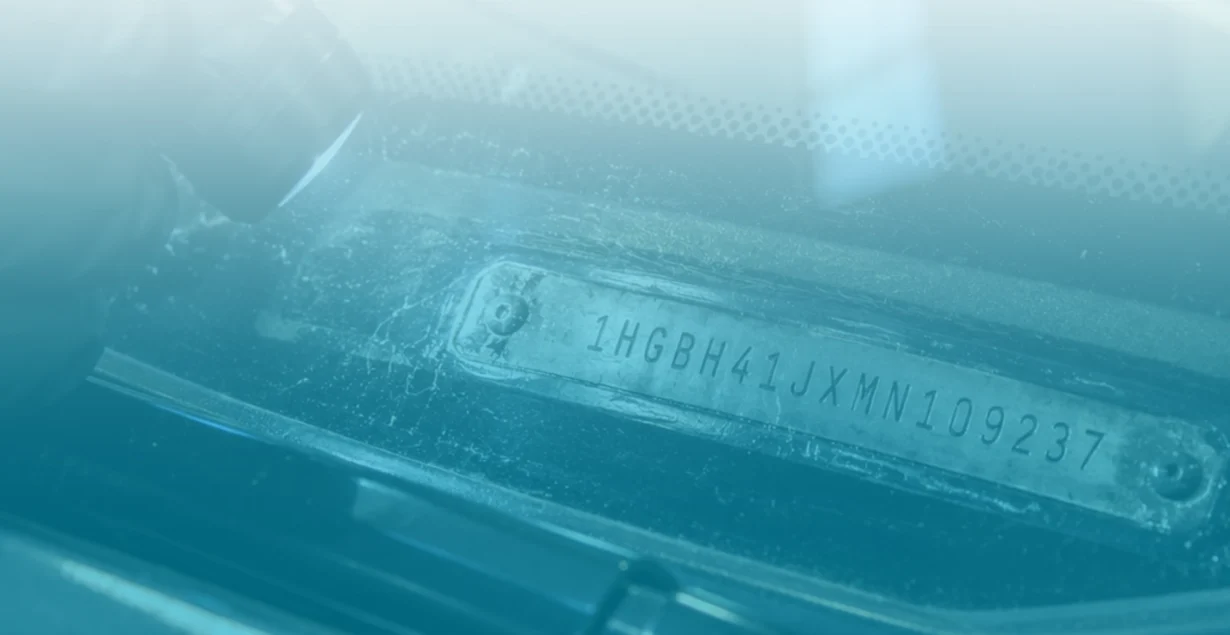

A fake VIN can look just like a real one. It may have all 17 characters and even pass the check digit test.
So, how can you tell if a VIN is fake? Let’s look at the warning signs, how to spot fraud, and when fake VIN generators are actually useful.
Key takeaways
- Vincario offers a free full vehicle check from a single VIN. Decode specs, check theft status and market value with 3 free reports every month, no credit card.
- The check digit catches typos, not fraud. In our test, it flagged 92% of single-character changes, but cloned VINs passed because they use real numbers.
- Cross-checking beats inspection alone. Compare VIN locations, decoded specs, and vehicle history. One mismatch is a red flag.
What is a fake VIN number?
A fake VIN is any vehicle identification number that doesn’t truthfully belong to the vehicle carrying it. There are five types, and each requires a different check.
| Type | What it is | Passes check digit? | How you catch it |
|---|---|---|---|
| Invalid VIN | Made-up or mistyped characters | Usually no | Format + check digit math |
| Altered VIN | Original characters ground off and restamped | Sometimes | Plate inspection, decode mismatch |
| Cloned VIN | A real VIN copied from a legal car of the same model | Always | History + location mismatch |
| Swapped VIN | Plate moved from a salvage or written-off car | Always | Salvage/total-loss record, rivets, hidden VINs |
| Generated VIN | Random VIN from a generator, for software testing | Usually yes | Decodes to nothing or wrong specs, no history |
Only the last one is legitimate, and only when it stays inside software.
Not sure about your VIN? Vincario can decode it in seconds, showing vehicle specs to help you spot mismatches.
How to tell if a VIN number is fake? 7 checks
1. Check the format
A post-1981 VIN has exactly 17 characters. It never contains I, O or Q. Position 10 (model year) never uses U, Z or 0. Any of these violations means the VIN is invalid.
Tip: Pre-1981 cars use shorter VINs (often 11–13 characters). A short VIN on a classic isn’t fake by itself. A short VIN on a 2015 car is.
2. Do the check digit math
Position 9 is a check digit calculated from the other 16 characters. Convert letters to numbers, multiply by fixed weights, add everything up and divide by 11. The remainder must match position 9 (10 = X).
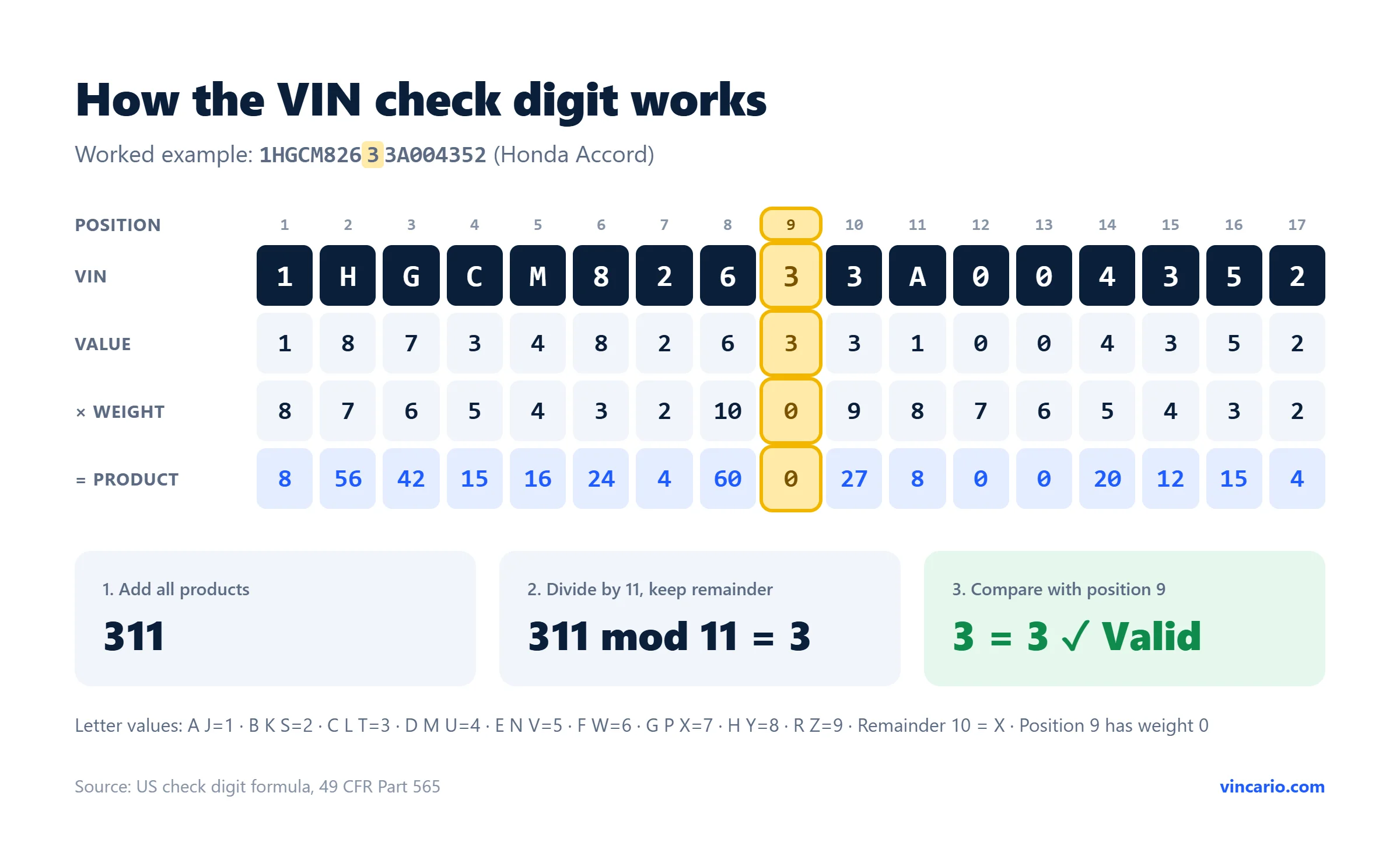
A random 17-character string passes this test only about 3% of the time (we tested 1,000,000 random strings). So a failed check digit is a strong red flag on any North American vehicle. Full step-by-step method: VIN number examples decoded.
Note: European and some Asian manufacturers don’t always use the check digit. A wrong 9th character on a European-market car isn’t proof of fraud.
3. Know what the check digit can’t see
We ran 20,000 valid VINs through every possible single-character change and every adjacent swap:
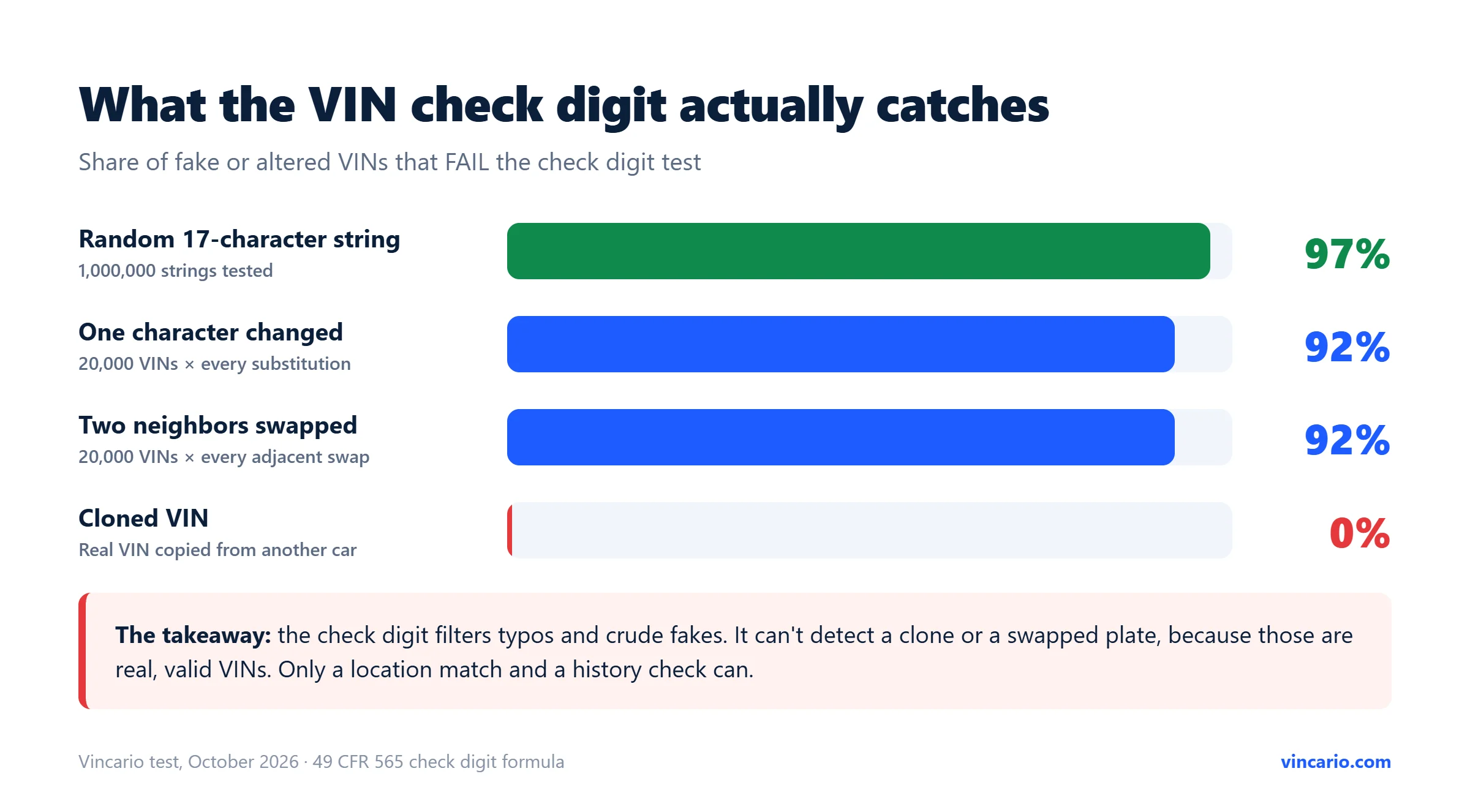
The check digit caught 92% of single-character changes and 92% of swapped neighbors. The 8% it misses aren’t random. They’re characters that share the same number in the formula:
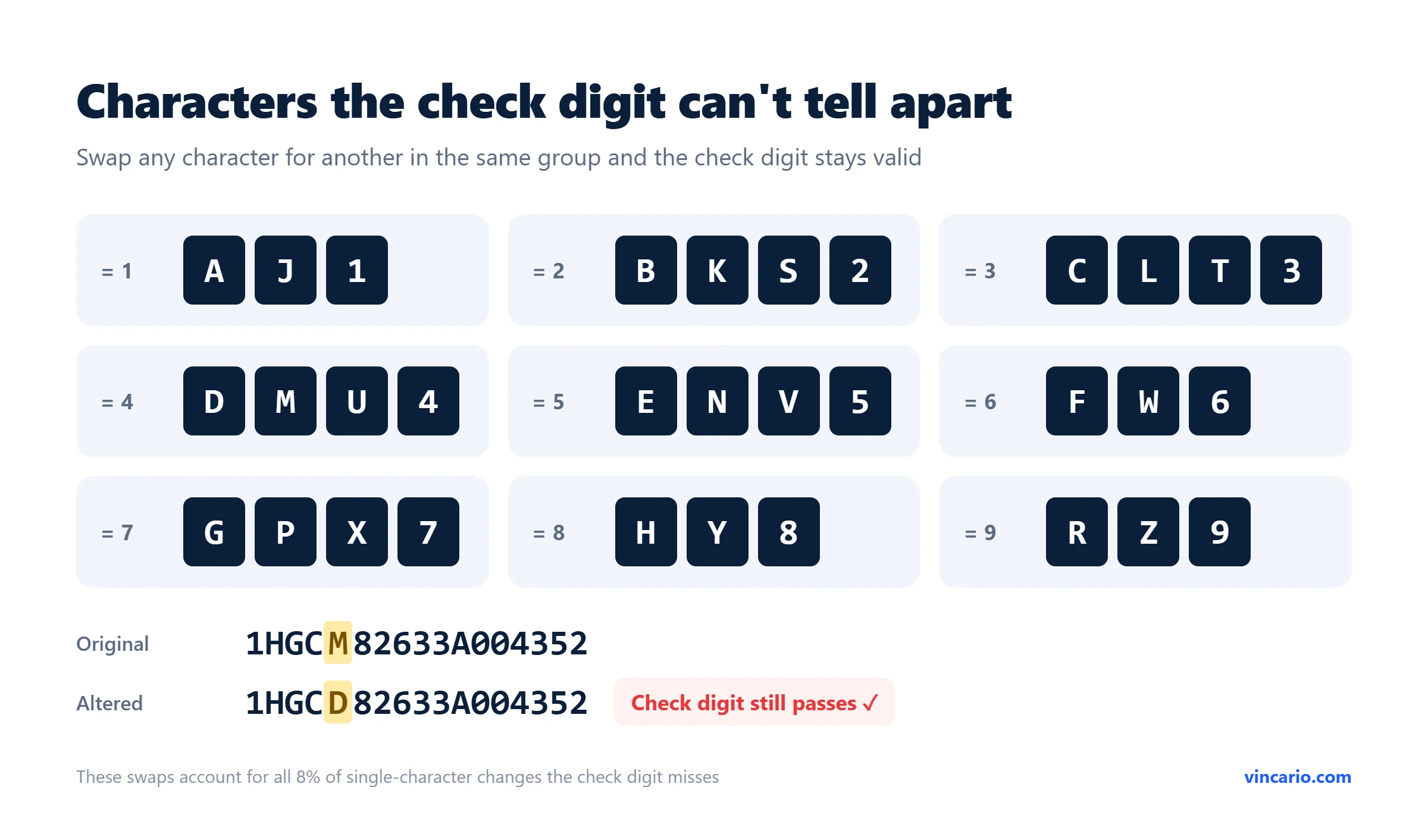
Change a 3 to a T, or an M to a D, and the check digit still passes. A forger who knows this can alter characters without breaking the math. And a cloned VIN is a real number, so the check digit catches 0% of clones.
Bottom line: the check digit filters typos and lazy fakes. Use it first, never last.
4. Match every VIN location
Thieves usually change the VIN plate on the dashboard because buyers look there. They rarely change all of the hidden ones.
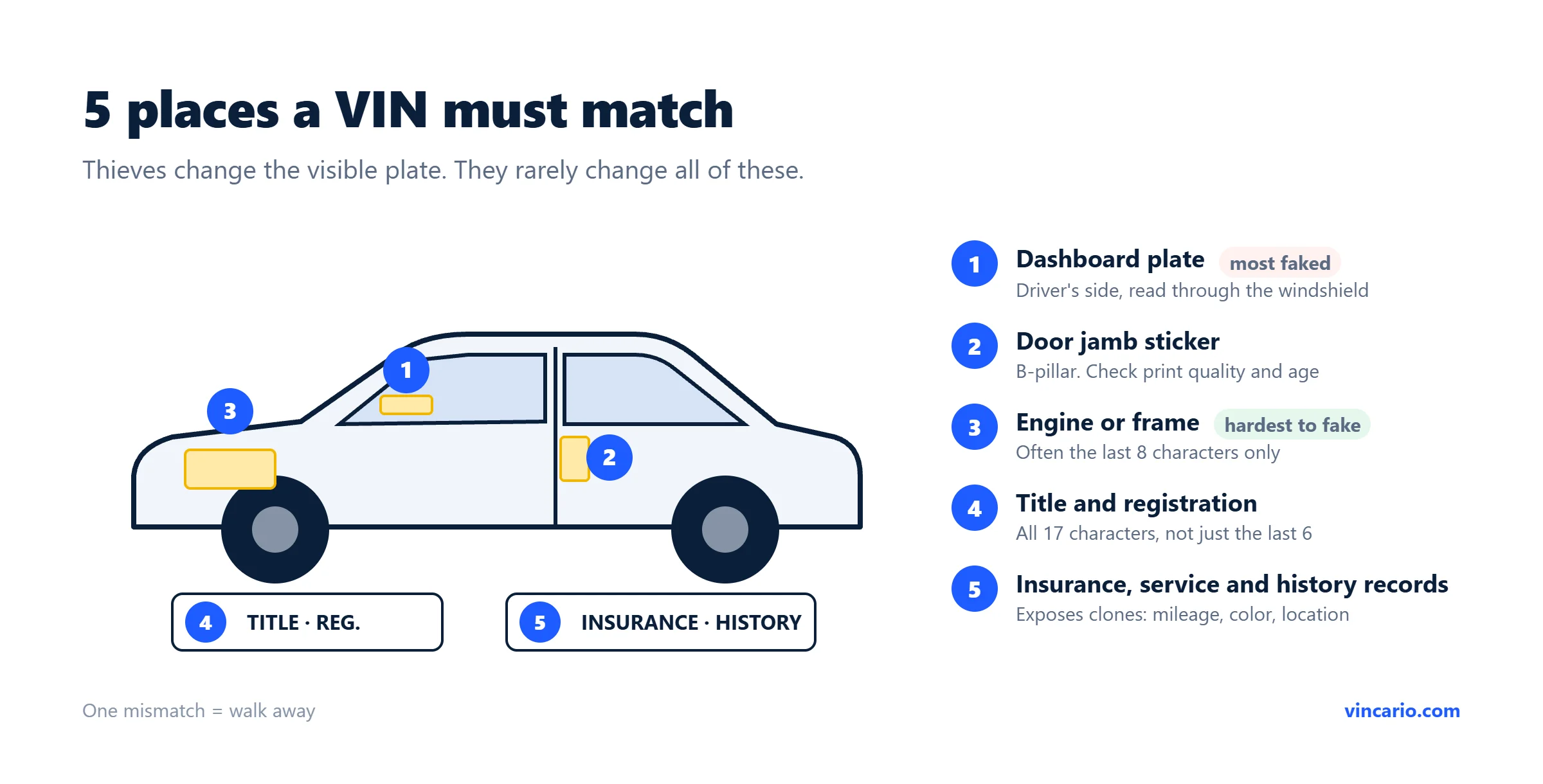
Check these five locations. Full 17-character VINs should match exactly, while partial VIN stamps should match the corresponding characters:
- Dashboard plate (visible through the windshield, driver’s side)
- Driver’s door jamb sticker (B-pillar)
- Frame, engine or firewall stamp (many engines and transmissions carry the last 8 characters)
- Title and registration
- Insurance card and service records
Scanning each VIN with an OCR scanner reduces reading errors and provides evidence of any mismatches.
5. Inspect the plate and sticker
Look for things a factory never leaves behind:
- Scratches, glue, or bent edges around the VIN plate
- Loose, mismatched, or unusually new rivets
- Uneven characters, mismatched fonts, or suspicious door stickers
6. Decode the VIN and compare it with the car
A VIN encodes the maker, plant, body, engine and model year. Run it through a free VIN decoder and compare the result with what’s in front of you.
Real red flags: the VIN decodes to a 4-cylinder sedan but the car is a V6 coupe, or it decodes to 2017 while the title says 2019. Clones are often taken from the same model in a different trim, so check engine, drivetrain and body style, not just make and model.
7. Run a history and theft check
This is where clones fail. The original VIN has its own history, and it rarely fits the car you’re looking at:
- Mileage records higher than the odometer
- Registrations in two different states at the same time
- Listing photos online showing a different color
- A salvage, total-loss or theft record on a “clean” car
Run a stolen vehicle check and a vehicle history report before you pay a deposit. If you’re worried about your own car being stolen, there are also simple ways to prevent car theft, such as using a steering wheel lock, protecting your keyless entry system, or installing a GPS tracker.
How can I tell if my Camaro VIN is fake?
Camaros are among the most cloned cars in the US, mostly because SS and Z/28 versions sell for far more than base cars. Specific checks:
- 2010–2015 (5th gen): built in Oshawa, Canada, so the VIN starts with 2G1.
- 2016–2024 (6th gen): built in Lansing, Michigan, so the VIN starts with 1G1. A 2018 Camaro starting with 2G1 is a red flag.
- 1967–1969 (1st gen): the VIN starts with 123 for a six-cylinder car and 124 for a V8. The 6th character is the year (7, 8, 9) and the 7th is the plant (N = Norwood, L = Van Nuys).
- SS and Z/28 aren’t in the first-gen VIN. A numbers-matching SS with a 123-series VIN started life as a six-cylinder car. It may be a fine restomod, but it isn’t an original SS.
Decode yours with the Chevrolet VIN decoder and compare engine and plant with the car. For classics, have the cowl tag and engine stamp checked by a marque specialist before buying.
What to do if you find a fake VIN?
- If you’re buying: Walk away, avoid confronting the seller, and save the listing and photos.
- Already own it: contact your local police and insurer, then the DMV. Don’t try to fix the VIN yourself.
- Report it: use the Vincario theft report form so the VIN gets flagged for other buyers.
In the US, knowingly altering or removing a VIN is a federal crime under 18 U.S.C. § 511, with up to 5 years in prison. Buying a car with a fake VIN in good faith isn’t a crime, but the car can still be seized.
Fake VIN generators: what they are and when to use them?
A fake VIN generator creates random, correctly formatted VINs. Developers use them to test forms, databases and VIN decoder APIs without touching real vehicle data. Here’s how the common tools compare:
| Generator | Valid check digit | Filters | Best for |
|---|---|---|---|
| Logisoft VIN Generator | Yes (ISO 3779) | Make, model year, country | Realistic single VINs, auto-decoded |
| RandomVIN.com | Not stated | Not stated | Quick dev testing (maintained by VinAudit) |
| Glima AI Random VIN | Not stated | Vehicle type, model, year | Themed demo data (muscle car, EV, SUV) |
| Faker (faker-js vehicle.vin()) | Verify before use | None | Bulk test data inside code |
Tip: If your app validates the check digit, run generated VINs through the formula above first. A generator that skips it will make your tests fail for the wrong reason.
What a generated VIN can’t do?
- Decode to a complete, real vehicle. Most return partial specs or nothing.
- Pass a history, title or theft database. There’s no record behind it.
- Be used on a vehicle, registration, insurance policy or listing. That’s fraud, not testing.
Need VINs that decode fully? Use real public examples instead. We decoded 8 of them in our VIN number example guide.
How to make a fake VIN number for testing?
- Pick a real WMI (positions 1–3), e.g. 1HG for Honda US, so decoders recognize the maker.
- Fill positions 4–8 with allowed characters (no I, O, Q).
- Set position 10 to a valid year code (e.g. N = 2022, P = 2023, R = 2024).
- Add a plant code and serial (positions 11–17).
- Calculate position 9 with the check digit formula.
Keep test VINs in test environments and label them clearly in your database.
Is it safe to run a VIN check?
Yes. A VIN isn’t personal data. It identifies the vehicle, not the owner, and VIN lookups don’t reveal names or addresses. The only risk is a site that asks for payment details for a free check. Stick to known free VIN decoders.
Final words
A fake VIN may pass individual checks but fail when you compare the records. The plate says one thing, the door sticker another, the history a third. Check the format and check digit in seconds, then match every location and run the history before money changes hands.
Check any VIN with Vincario for free. Specs, theft status and market value in one report.

FAQ
1. How to tell if a VIN number is fake for free?
Use the check digit formula and a free decoder. Vincario decodes the VIN and checks theft status at no cost with 3 free reports per month.
2. Can a fake VIN pass a VIN check?
A cloned VIN can pass a basic decode. It’s a real number, so the specs look right. The history check is what exposes it: mileage, location and title records won’t match the car.
3. Is a fake VIN generator legal?
Yes, for software testing. Generating random VINs for development is legal. Putting one on a vehicle, title or insurance application is fraud.
4. Where can I get a fake VIN number for testing?
From a VIN generator like Logisoft or RandomVIN, or Faker in code. If you need full decoding results, use real public sample VINs instead.
5. What is a fake VIN sticker or plate?
A counterfeit label or plate made to replace the original. Signs include fresh printing on an old car, mismatched rivets, glue marks and a different font from other VIN locations.
6. Can a fake VIN report be detected?
Yes. Run the VIN yourself. Sellers sometimes show edited history PDFs. Never rely on a report the seller provides; pull your own from a trusted source.
7. Is it safe to run a VIN check?
Yes. VIN lookups don’t expose owner data, and the VIN is visible through every windshield anyway.
8. Can a car have two VINs?
Legally, only after a state reassigns one (for example after a rebuild). The new VIN then appears on the title. Two different VINs on one car without paperwork is a red flag.