




What does a VIN really cost and why do some VIN decoders end up being far more expensive than others?
In this article, you’ll find the best options for VIN Decoder API pricing. We’ll show what you’re truly paying for, how pricing models differ, and how to choose the right VIN data solution for real automotive workflows.
Why VIN Decoder APIs aren’t priced like “normal” APIs
A VIN may look like just 17 random characters, but it actually works like a vehicle’s ID card. A good VIN decoder doesn’t just identify the car. It returns a usable specification: trims, engines, transmissions, fuel, drive, body type, emissions attributes, market context, and other important details you can rely on.
VIN Decoder API pricing largely depends on how smart the technology is. The more advanced the algorithms, the more accurate, complete, and reliable the results become—and that directly affects the cost.
Higher-priced solutions usually rely on:
- Intelligent decoding logic that works across many countries, years, and manufacturers.
- Advanced data processing that delivers clear, consistent vehicle details every time.
- Built-in accuracy controls that catch errors and filter out invalid VINs.
- Data enrichment technology that adds value, such as pricing insights or theft checks.
- Robust infrastructure designed for speed, stability, and continuous availability.
The price reflects the technology used to turn a VIN into accurate and reliable vehicle data.
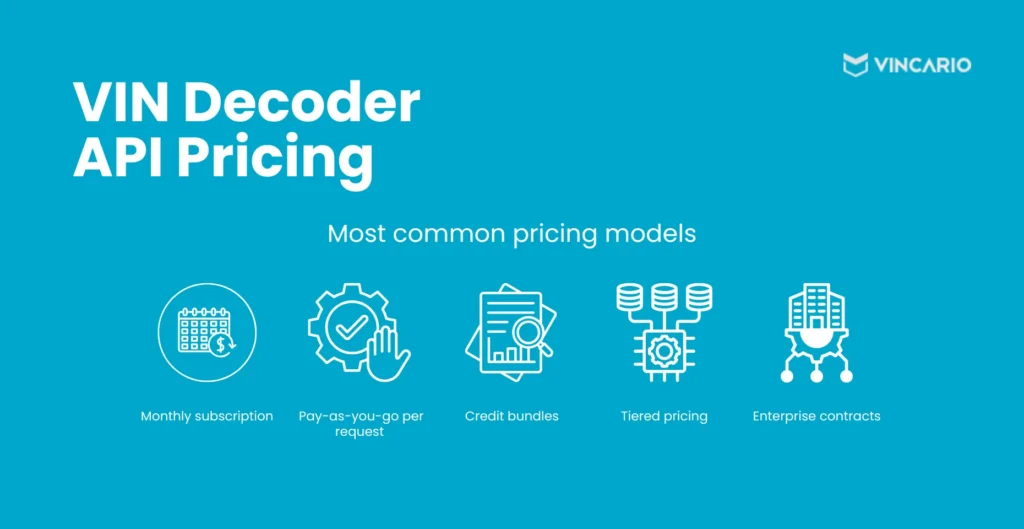
5 Pricing Models of VIN Decoder API
1) Monthly subscription with included lookups (most common in B2B)
You pay a fixed monthly fee that includes a quota (e.g., X lookups/month). It’s predictable, budget-friendly, and easy to sell internally.
Vincario uses a subscription-based pricing model with monthly lookup limits. You can test the VIN API with 20 free VIN lookups, after which a paid plan is required.
Who should choose this model
- Dealership groups, marketplaces, CRMs, DMS add-ons
- Fleet onboarding flows where usage is steady
- Any product that wants predictable spend
Hidden gotcha to watch
- How the provider treats overages (pause vs. bill-through)
2) Pay-as-you-go per request (great for spiky demand)
Here, you’re charged for every successful request. This is popular with developer-first platforms and fast prototypes.
A public example is Dataone software VIN decode API pricing, which includes a free tier and then per-call rates (with different per-call costs by plan).
Who should choose this model
- Startups still finding product-market fit
- Usage that varies widely month to month
Gotcha
- If you’re decoding large batches, PAYG can quietly outgrow subscriptions. (The most expensive option)
3) Credit bundles (prepaid packs)
You buy blocks of credits and spend them on decoding and add-on services.
This is common in consumer report ecosystems and smaller B2B workflows, but be careful: credit systems often blur the real per-lookup cost—especially when different endpoints consume different amounts.
Providers often differentiate between web reports and API calls in how they’re charged. Vincario’s terms clarify that API usage is charged per successful request to an API endpoint (while web reports may behave differently, such as being charged once per VIN in certain contexts).
Vincario offers small businesses and consumers a package of 3 free reports every month.
4) Tiered pricing by data depth (spec vs. OEM build vs. history)
Not all VIN decodes are equal. Many providers separate:
- “Basic decode” (year/make/model)
- “Full spec” (engine, transmission, body, drive, etc.)
- “OEM build data” (factory equipment, build sheet–like details where available)
- “History / risk” (theft signals, title/claims, etc.)
- “Market context” (values, comps, depreciation signals)
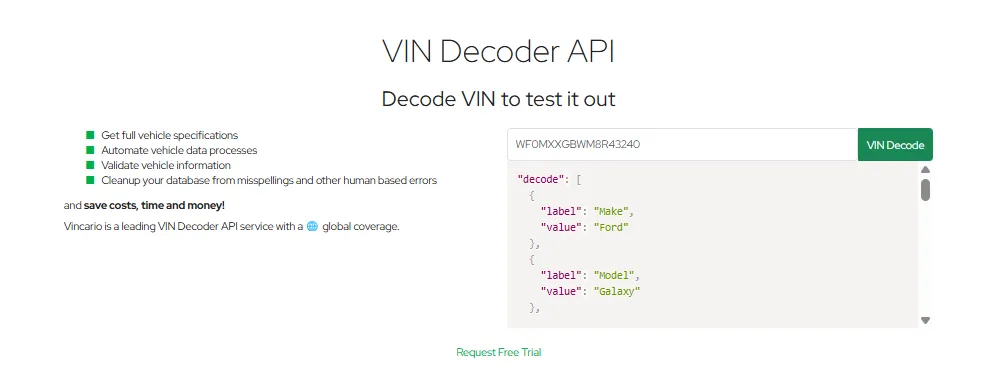
Vincario’s API documentation lists multiple endpoints, including VIN Decode Info, OEM VIN Lookup, Vehicle Market Value, Stolen Check, and Balance.
5) Enterprise contracts (custom SLA + throughput)
At high volume, you’re not only paying for data—you’re paying for:
- Custom SLAs
- Higher RPS limits
- Dedicated support
- Custom coverage requests or data agreements
- Legal/DPAs and security reviews
Even if your business starts on self-serve plans, it’s normal to graduate here.
The “overage clause” is where pricing gets real
Two providers can both claim “10,000 lookups/month,” but the moment you exceed it, your experience diverges dramatically.
On Vincario’s pricing FAQ, exceeding the limit can mean either:
- Pause-and-wait until the next billing cycle, or
- Always active (automatic renewal-style behavior where additional usage is billed at the same per-lookup price), or
- Upgrade to a higher plan.
That’s more than billing—it’s product reliability. If you run a checkout flow, onboarding funnel, or claims workflow, “API paused” can become “sales paused.”
Pro tip: choose overage behavior based on business risk:
- Pause is fine for back-office batch processes.
- Always active is safer for user-facing flows.
What actually drives VIN Decoder API price up or down?
Coverage: “Global” costs more than “US-only”
If your product serves Europe (or truly global markets), you’ll quickly see why global coverage is priced differently. A free US-only decoder is not equivalent to a global commercial decoder.
For example, the US government’s NHTSA vPIC VIN decoding tools and API exist and are publicly accessible—useful, but primarily aligned with US datasets and public-domain constraints.
Data cleanliness: “raw” vs. “ready to automate”
An API that returns inconsistent values (“VW” vs “Volkswagen”) or mixed trim naming can be “cheap,” but you’ll pay later in:
- support tickets
- mapping logic
- search/index errors
- incorrect fitment
- mismatched inventory or valuation
Throughput and rate limits
If you decode VINs at scale—think 5k VINs/day imports rate limits matter as much as unit price.
Vincario applies an API rate limit of 60 VIN lookups per minute to ensure stable and reliable performance.
Fraud and validation rules
One underappreciated pricing lever: charging policy for invalid VINs.
Vincario states that invalid or unrecognized VINs are not charged, and valid VIN requests count as one lookup.
That matters if you ingest user-entered VINs or OCR output.
Vincario API services
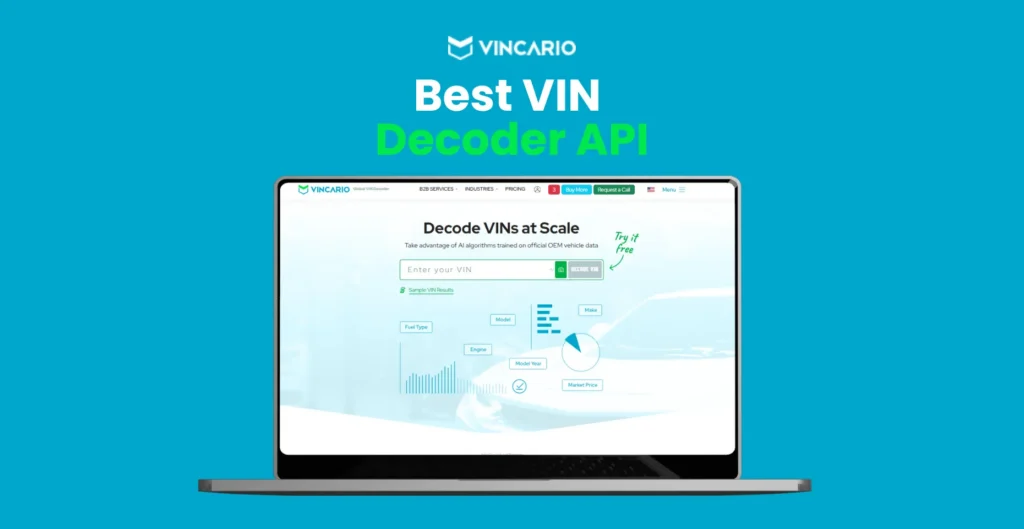
Vincario isn’t just a VIN decoder. It’s best understood as a vehicle data toolkit where your pricing strategy depends on which decisions you’re trying to automate.
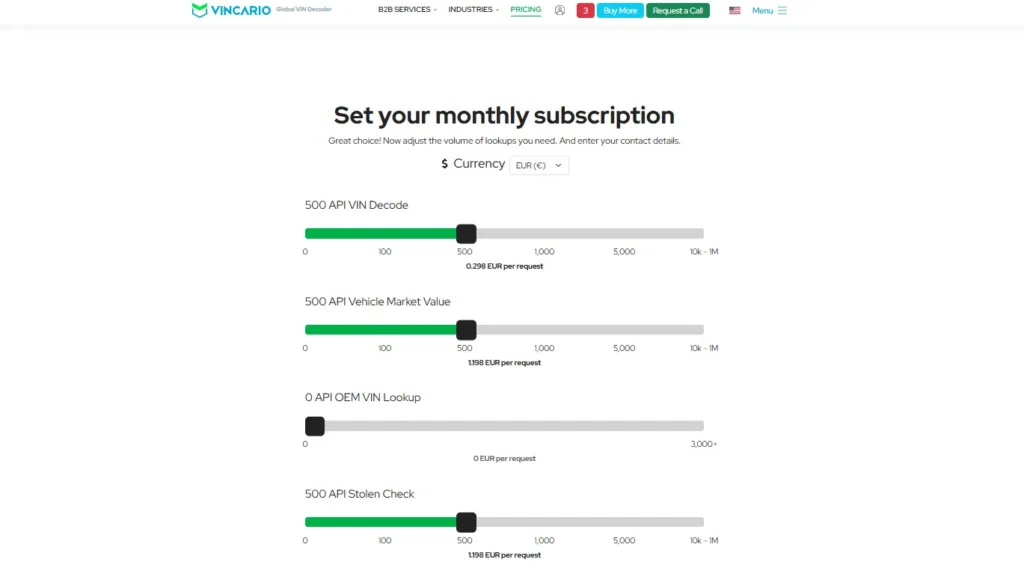
Take a look at the overview of pricing for Vincario VIN API services.
1) VIN Decoder API
Your core vehicle identity: make, model, year, and deeper spec details for downstream logic. Ideal for vehicle onboarding, inventory management, and service workflows.
VIN Decoding API Prices:
100 VIN lookups – €0.49 per request
500 VIN lookups – €0.298 per request
1,000 VIN lookups – €0.249 per request
5,000 VIN lookups – €0.22 per request
10,000+ VIN lookups – Custom pricing on request
2) OEM VIN Lookup
When you need a more OEM-flavored layer (where available), this endpoint sits above basic decoding as a deeper “what exactly was built?” style lookup.
Best for
- precise equipment/variant logic
- reducing “wrong trim” mistakes in cataloging
OEM VIN Lookup API Prices:
OEM lookups – Custom pricing on request
To compare other OEM software solutions, read this article.
3) Vehicle Market Value API
This is where VIN becomes money: valuation signals that help you price inventory, underwrite, or spot outliers. Vincario explicitly positions this service for API or web use.
Best for
- marketplaces and resellers
- fleet valuation and finance contexts
- insurance alignment and asset valuation
Vehicle Market Value API Prices:
100 VIN lookups – €1.99 per request
500 VIN lookups – €1.198 per request
1,000 VIN lookups – €0.999 per request
5,000 VIN lookups – €0.90 per request
10,000+ VIN lookups – Custom pricing on request
4) Stolen Vehicle Check
Risk signal. Not every workflow needs it, but if you operate in trade-ins, onboarding, compliance, or claims, it’s often worth the incremental cost.
Stolen Vehicle Check API Prices:
100 VIN lookups – €1.99 per request
500 VIN lookups – €1.198 per request
1,000 VIN lookups – €0.999 per request
5,000 VIN lookups – €0.90 per request
10,000+ VIN lookups – Custom pricing on request
5) VIN OCR Scanner
If VINs enter your system via photos (dash plate, door jamb, documents), OCR turns messy human input into machine-ready VINs—then the decoder can validate and enrich it.
VIN OCR Scanner – Custom pricing on request
TIP: If you want to see the best VIN scanners for dealerships, read this article.
6) License Plate Lookup
When users don’t have the VIN (common in casual shopping journeys), plate lookup can reduce friction and increase conversion—especially in lead-gen flows. (It’s listed among Vincario’s B2B services and navigation items.)
License Plate Lookup Prices:
Completely Free – with no limits
7) Global VIN Decoder (web experience)
Vincario also offers a web-based “Global VIN Decoder” entry point, including a free monthly allowance for new customers (3 free lookups/month).
This matters for pricing strategy because it lets teams validate data quality before implementing.
3 Free reports – each month
A practical way to estimate your “true” VIN decode cost
Instead of asking “How much per lookup?”, model it like this:
True cost per vehicle processed =
(Decode cost) + (Enrichment cost) + (Failure cost) + (Engineering cost)
Where:
- Failure cost includes wrong-part returns, bad pricing, fraud exposure, manual review time.
- Engineering cost includes maintaining mappings, re-tries, caching, and support escalations.
In parts catalogs and aftersales, the failure cost can dwarf the API bill. One wrong fitment outcome can erase the savings of thousands of “cheap” decodes.
How to choose the right plan
Step 1: Define your stage
Startups and prototypes should begin with pay-as-you-go or a small subscription, combined with smart caching to control costs.
Step 2: Match the API to your business model
Marketplaces benefit most from combining the VIN Decoder with Vehicle Market Value data, with Stolen Check added for extra security.
Step 3: Optimize vehicle onboarding
Fleet and telematics platforms should use the VIN Decoder together with VIN OCR to speed up onboarding from photos and documents.
Step 4: Focus on accuracy where it matters
Aftermarket and parts businesses should pair the VIN Decoder with OEM VIN Lookup to avoid costly specification mistakes.
Step 5: Manage risk early
For compliance-focused workflows, adding Stolen Vehicle Check from the start helps reduce legal and operational risks.
Looking to improve your fleet operations? This article shares creative strategies and professional tips you don’t want to miss.
Conclusion
VIN Decoder API pricing is not just about cost, it is about confidence, accuracy, and long-term value. The right solution saves time, prevents mistakes, and helps your business make better decisions from the very first lookup.
Ready to automate your VIN workflow? Book a demo and discover the best VIN Decoder API with Vincario.
Learn more in our What Is Vincario? guide.