



Need to know what happened to a used car before you buy it?
autoDNA focuses on vehicle history, damage, mileage, theft records, previous use, equipment, and archived photos. Here’s what you get, what it costs, and how it compares with API-focused alternatives.
Key Takeaways
- autoDNA provides vehicle history reports, not just basic VIN decoding.
- A single report costs €24.99, dropping to €9.59 per report on the 100-report Enterprise package.
- Its database covers 26+ countries in Europe and North America, with data sourced from 50,000+ institutions.
- autoDNA offers WebAPI access for partners, but it is not presented as a public self-service developer API.
What Is autoDNA?
autoDNA is a Polish vehicle history provider operating since 2010. Its reports combine records from dealerships, workshops, insurers, inspection stations, financial institutions, government sources, police databases, and other automotive organizations.
The main use case is simple: enter a VIN and check a used vehicle before buying or selling it.
What Does an autoDNA Report Include?
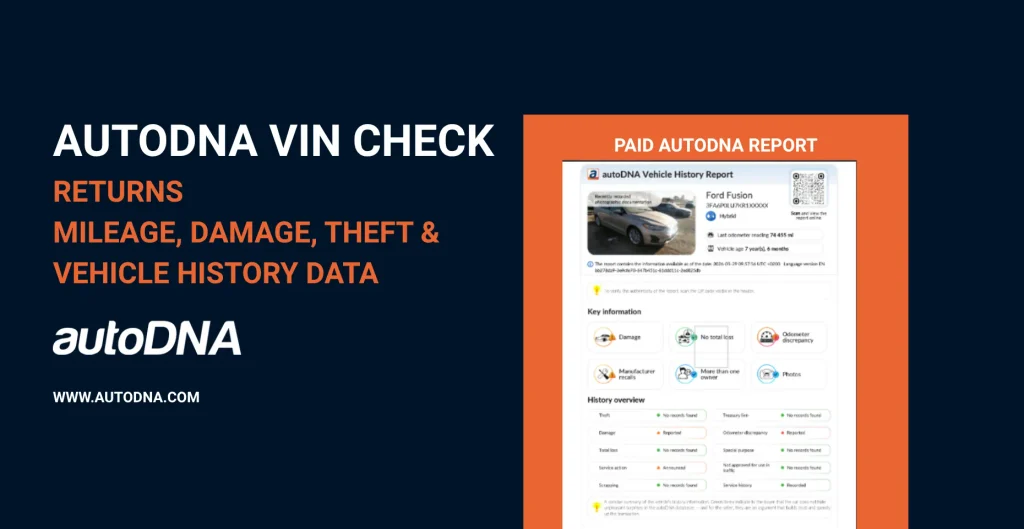
Depending on the VIN and available records, an autoDNA report can include:
- Damage and accident records
- Odometer readings
- Stolen vehicle records
- Technical data and equipment
- Previous vehicle use
- Manufacturer recalls
- Archived photos
- Liens and financial records
The amount of information varies by vehicle. Importantly, autoDNA says users can see what categories of information are available before purchasing the full report.
autoDNA Pricing
autoDNA uses prepaid reports and report bundles rather than a standard monthly consumer subscription.
| Package | Price | Reports | Price / Report | Validity |
|---|---|---|---|---|
| Single | €24.99 | 1 | €24.99 | 90 days |
| Duo | €39.99 | 2 | €19.99 | 90 days |
| Triple | €49.99 | 3 | €16.66 | 90 days |
| Premium | €259 | 20 | €12.95 | 210 days |
| Professional | €559 | 50 | €11.18 | 210 days |
| Enterprise | €959 | 100 | €9.59 | 210 days |
Prices and validity periods are published on autoDNA’s official packages page.
Bulk packages significantly lower the cost per report, but unused reports expire, so the largest package only makes sense if you expect to use the volume.
Is the autoDNA VIN Check Free?
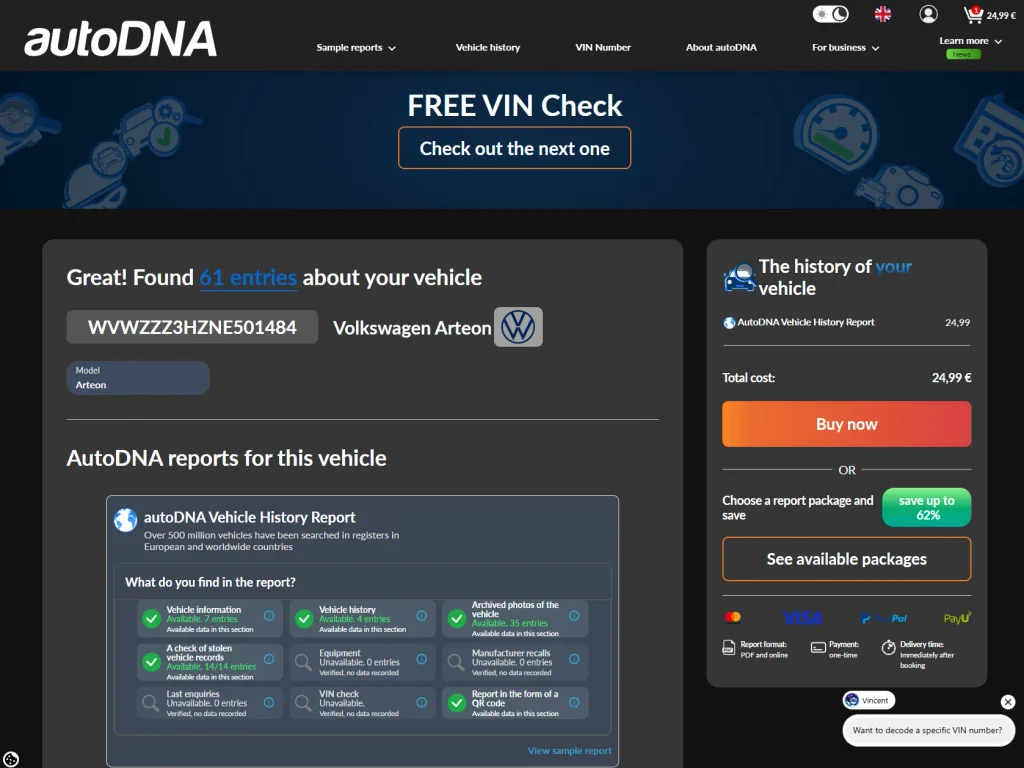
The initial VIN check is free and shows whether autoDNA has relevant records for the vehicle. Access to the detailed vehicle-history information requires a paid report.
Tip: Check which sections contain data before paying. autoDNA itself recommends doing this for each VIN.
autoDNA Advantages and Disadvantages
| Category | ✅ Pros | ❌ Cons |
|---|---|---|
| Cost | Free preliminary VIN check | Full history starts at €24.99 |
| Main purpose | Detailed used-vehicle history | Less suitable for detailed VIN specification decoding |
| Vehicle history | Damage, mileage, theft, photos, recalls | Available data varies by VIN |
| Coverage | 26+ countries in Europe and North America | Record depth can vary by market |
| Data sources | 50,000+ automotive and institutional sources | Source records may contain errors |
| API access | WebAPI available to partners | Not a public self-service API |
| Bulk use | Discounts for 20–100 reports | Packages expire after 210 days |
| Best use case | Checking a used vehicle before purchase | Less direct for global VIN-data automation |
autoDNA itself notes that reports depend on external data sources and recommends verifying important information independently.
autoDNA Reviews
autoDNA currently has 2.2/5 from 680 Trustpilot reviews. About 71% are 1-star reviews, while 19% are 5-star reviews. Recent negative reviews often mention limited information in some reports, while positive reviewers describe finding useful mileage, damage, and vehicle-history records.
Our view: autoDNA can provide useful history data, but there is no free full report. The free check only confirms basic vehicle details, such as make and model. Detailed mileage, damage, theft, and history records require a paid report.
autoDNA Alternatives
autoDNA is mainly a history-report service. If your priority is structured VIN specifications, automated decoding, OCR, or vehicle-data integration across more markets, an API-focused platform may be more suitable.
autoDNA vs. Vincario
| Feature | autoDNA | Vincario |
|---|---|---|
| Trustpilot reviews | 2.2/5 (680 reviews) | 4.6/5 (39 reviews) |
| Primary focus | Vehicle history reports | VIN decoding and vehicle-data APIs |
| Data sources | Dealers, insurers, police, inspection records, financial records, and other sources | OEM, partner, aggregated, and proprietary vehicle data |
| Data depth | Mileage, damage, theft, equipment, photos, recalls | Detailed vehicle specifications plus additional data services |
| Accuracy | No public percentage; accuracy depends on external records | 99.8% data accuracy claimed |
| Coverage | 26+ countries in Europe and North America | 110 countries, 2,400+ brands |
| Vehicle Market Value | No dedicated market-value API listed | Dedicated Vehicle Market Value API |
| Stolen check | Included where records are available | Dedicated Stolen Vehicle Check |
| VIN scanner | No dedicated OCR VIN scanner listed | VIN OCR Scanner for images and documents |
| License plate lookup | VIN or registration number can be used for reports | Dedicated License Plate Lookup |
| API access | Partner WebAPI by arrangement | Public REST API and documentation |
| Vehicle types | Cars, trucks, buses, motorcycles, mopeds with compatible 17-character VINs | Cars, vans, trucks, buses, motorcycles, trailers, tractors, ATVs and more |
| Pricing | €24.99/report; bulk pricing from €9.59/report | 3 free vehicle reports per month |
| Best for | Used-car history checks | Automated VIN data and automotive software |
The key difference is history vs. identification: autoDNA is built around what has been recorded about a vehicle, while Vincario is built around identifying the vehicle and returning structured data that software can use.
Does autoDNA Have an API?
No. autoDNA’s business and enterprise packages are volume discounts on consumer-style reports, not a documented API. There is no public developer documentation, no REST endpoint, and no mention of programmatic integration on autoDNA’s site.
If your business needs to decode VINs automatically inside a website, app, or internal system, rather than buy one-off reports for individual buyers, autoDNA isn’t built for that job.
How to Use the autoDNA VIN Check?
- Go to the autoDNA VIN check page.
- Enter the vehicle’s 17-character VIN.
- Review the free preliminary result, which confirms basic details and photo availability.
- Choose a report package that matches how many VINs you plan to check.
- Purchase and open the full report for ownership, mileage, damage, and theft data.
Final Words
Need to know a car’s past or decode vehicles at scale?
autoDNA is built for vehicle-history checks, while Vincario focuses on structured VIN data and automation. The right choice depends on whether you need to investigate one vehicle or feed vehicle data directly into your product.
FAQ
1. Is autoDNA Legitimate?
Yes. autoDNA has operated since 2010 and is registered in Łódź, Poland. Its reports use data from thousands of automotive and institutional sources.
2. How Much Does an autoDNA Report Cost?
A single report costs €24.99. Bulk packages reduce the cost to as little as €9.59 per report for 100 reports.
3. Does autoDNA Check for Stolen Vehicles?
Yes. Its vehicle-history reports can include checks against stolen vehicle databases, depending on available records.
4. Why Does an autoDNA Report Have Limited Information?
The available information depends on the specific VIN and records supplied by external sources. autoDNA shows the available data categories before purchase, so check them first.
5. Can autoDNA Check Motorcycles and Trucks?
Yes. autoDNA supports cars, trucks, buses, motorcycles, and mopeds provided they have a valid 17-character VIN compliant with ISO 3779 standard.
6. Does autoDNA Work With Classic Cars?
Coverage is mainly designed for vehicles manufactured after 1981 with a standardized 17-character VIN. Older classic cars with shorter or non-standard VINs may therefore not be supported.
7. Does autoDNA Cover Germany, Poland, and Romania?
Yes. autoDNA covers many European countries, including Germany, Poland, and Romania, although the amount of available history data can vary by vehicle and country.