




Free. Simple. US-focused. That’s why many developers start with the NHTSA VIN decoder API.
But is it enough for your needs? Let’s break it down.
Key Takeaways
- The NHTSA VIN decoder API is free but limited.
- It provides basic vehicle specs, not full vehicle intelligence.
- It is best for prototypes and simple use cases, not advanced products.
- Alternatives like Vincario offer better accuracy, depth, and scalability.
What does NHTSA stand for?
The National Highway Traffic Safety Administration (NHTSA) is a U.S. government agency focused on road safety.
It collects, manages, and publishes vehicle-related data, including VIN information, recalls, crash data, and safety ratings.
What does the NHTSA do?
NHTSA’s role is simple: to make roads safer by reducing accidents, injuries, and fatalities through data, regulation, and safety programs. It does this by:
- Setting and enforcing vehicle safety standards
- Investigating recalls and safety defects
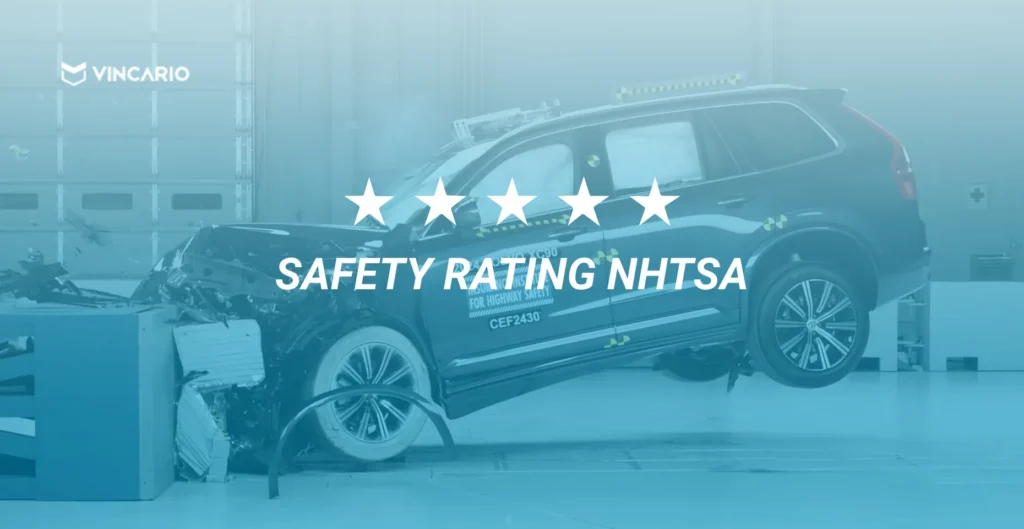
- Running crash tests (NCAP) and publishing safety ratings
- Providing vehicle and VIN data through public tools and APIs
NHTSA also supports research and safety campaigns based on real-world data. It’s a trusted public source, but it doesn’t offer commercial or enriched vehicle data.
What information can I get from the NHTSA VIN lookup?
The NHTSA VIN decoder returns manufacturer-submitted data.
You can get:
- Make, model, model year, manufacturer
- Engine type, cylinders, displacement, fuel type, drivetrain
- Body type, vehicle class (SUV, sedan, truck), drive type
- Plant location, country, and production information
- Airbags, safety systems, and sometimes recall-related fields
- Transmission type, brake system, and more
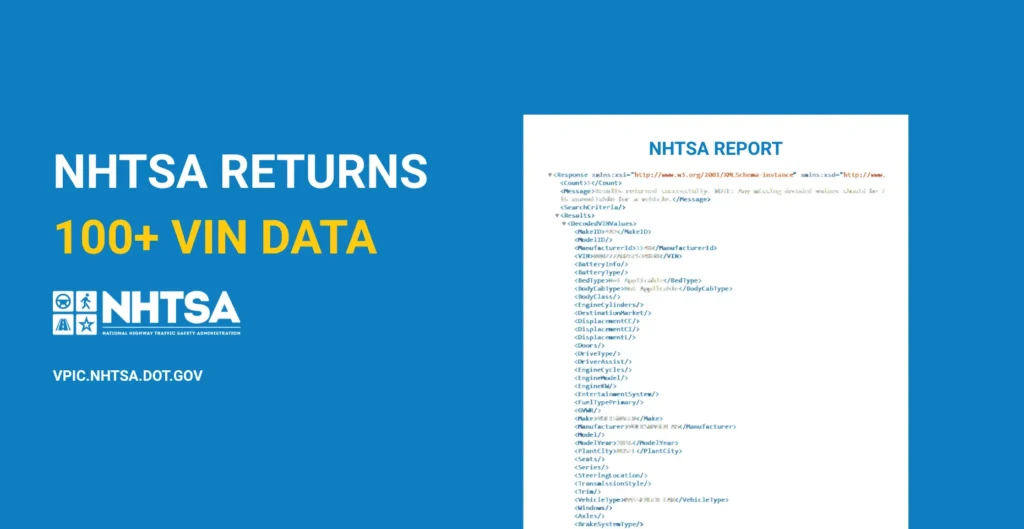
In total, the API can return 100+ data points per VIN, depending on the vehicle.
NHTSA advantages and disadvantages
Before you choose the NHTSA VIN decoder API, it’s important to understand where it works well and where it has limitations. Here’s a clear breakdown to help you decide if it fits your use case:
| Category | ✅ Pros | ❌ Cons |
|---|---|---|
| Cost | Free, no API key needed | No premium features |
| Data source | Official manufacturer data | No enriched data |
| Data depth | Basic specs (make, model, engine) | No trim, equipment, pricing, or history |
| Coverage | Good for US vehicles | Limited global coverage |
| Ease of use | Simple REST API, easy to use | Requires manual data processing |
| Integration | Quick setup, no authentication | No SDKs or advanced tools |
| Performance | Stable for small usage | Not ideal for large-scale use |
| Support | Public documentation | No support or SLA |
| Use case | Good for testing and basic apps | Not suitable for advanced use cases |
NHTSA alternatives
If you need more than basic specs, it’s worth exploring other options. We’ve compared the best VIN decoder APIs in 2026 in a separate guide to help you choose the right solution.
If you need more than specs, consider:
- Vincario – global, high accuracy, full vehicle data
- VehicleDatabases – scalable, global coverage
- DataOne Software – OEM-level precision
These APIs turn VINs into business-ready data.
NHTSA vs. Vincario
| Feature | NHTSA VIN API | Vincario VIN API |
|---|---|---|
| Purpose | Basic VIN decoding | Full vehicle data and insights |
| Data source | Manufacturer data (vPIC) | OEM + aggregated + proprietary data |
| Data depth | Basic specs only | Trim, equipment, pricing, and stolen check |
| Accuracy | Pattern-based | High accuracy, enriched data |
| Coverage | US-focused | Global (100+ countries) |
| Market data | Not available | Pricing and market value |
| Performance | Limited for scaling | Built for production use |
| Range of VIN decoding | Full 17-character VINs only | Full VINs + anonymized formats supported |
| Vehicle types coverage | Standard vehicles | Cars, trucks, motorcycles, trailers, more |
| Support | No support or SLA | Support and enterprise options |
| Error detection | Basic error messages | Advanced error detection and validation |
| Pricing | Free | Paid (scalable plans) |
Vincario is a professional vehicle intelligence solution with global coverage. If you want to see it in action, book a call with our sales team.
How to use the NHTSA VIN decoder API documentation?
Step 1: Open the official NHTSA vPIC API documentation.
Step 2: Choose an endpoint such as DecodeVin or DecodeVinValues.
Step 3: Add your VIN to the request URL (optionally include model year for better accuracy).
Step 4: Set the response format (JSON is recommended).
Step 5: Send the request via browser, Postman, or your app.
Step 6: Parse and use the structured response in your system.
NHTSA reviews
The NHTSA VIN decoder API is widely discussed across developer communities like Reddit and Facebook. Users appreciate that it’s free, easy to use, and based on official government data.
However, feedback also highlights its limits. It provides only basic specs, lacks detailed trim and equipment data, and can return incomplete results. Many developers need to combine multiple APIs to get full vehicle data. Overall, it’s a good starting tool, but not enough for advanced or production use.
Expert opinion – Martin Vlček, founder of Vincario
“We tested the NHTSA VIN decoder API in real use cases. It’s reliable, but only provides basic vehicle data, which is not enough for many businesses.
That’s why we built Vincario. It delivers enriched vehicle data with up to 99.8% accuracy, including detailed specs, trim, and insights for real-world applications.”
Final words
The NHTSA VIN decoder API is good for basic vehicle identification. But modern products need more: accuracy, detailed data, speed, and scalability.
When your product needs more, Vincario delivers. Scale your fleet management and automotive operations with precise VIN data.
FAQ
1. What is the NHTSA VIN decoder API?
The NHTSA VIN decoder API is a free public service that converts a VIN into basic vehicle information using manufacturer-submitted data. It provides core details like make, model, year, and engine, but does not include advanced data such as trim, pricing, or history.
2. How to use the NHTSA VIN decoder?
Use the NHTSA VIN decoder by sending a VIN to the official vPIC API endpoint (e.g., DecodeVin or DecodeVinValues). The API returns basic vehicle data in JSON, XML, or CSV format, and no API key is required.
3. What is the NHTSA responsible for?
The NHTSA is responsible forimproving road safety in the United States by setting and enforcing vehicle safety standards, investigating recalls and defects, conducting crash tests, and providing safety data and tools such as VIN decoding and recall lookup.
4. What is the NHTSA VIN standard?
The NHTSA VIN standard defines the 17-character Vehicle Identification Number format used in the U.S. It ensures each vehicle has a unique code that includes details like make, model, year, and manufacturing location. This standard helps identify and track vehicles for safety, compliance, and registration purposes.
Note: Sometimes the NHTSA shows the wrong model year. It can be off by up to 30 years.
5. What is NHTSA recalls?
NHTSA recalls are official safety recalls issued when a vehicle has a defect that affects safety.
6. How to check NHTSA recalls by VIN?
Enter a VIN into the NHTSA recall lookup tool or API to see any open or past recalls.
7. How many NHTSA recalls are there for a specific vehicle?
The number of NHTSA recalls varies for each vehicle and depends on its make, model, year, and production history. To get the exact number, you need to check the vehicle by VIN, which shows all recalls linked to that specific car.
8. What is a technical service bulletin (TSB) NHTSA?
A Technical Service Bulletin (TSB) is an official communication from a vehicle manufacturer that helps technicians diagnose and fix recurring issues more efficiently. It often includes detailed repair instructions, updated parts information, or known problem patterns.
TSBs are primarily used by service centers to improve repair accuracy and speed. They help address common issues, but they do not indicate a legally required repair like a safety recall.
9. What is NHTSA safety rating?
The NHTSA safety rating is a crash test rating that measures how well a vehicle protects occupants in different accident scenarios. It is part of the New Car Assessment Program (NCAP) and rates vehicles from 1 to 5 stars.
The rating is based on tests such as frontal, side, and rollover crashes, helping consumers compare vehicle safety and make informed decisions.
10. When was the NHTSA created?
The NHTSA was established in 1970.
11. Which industries use the NHTSA VIN decoder API?
The NHTSA VIN decoder API is used by industries that need basic vehicle identification and safety-related data.
- Automotive marketplaces – vehicle listing and identification
- Dealerships – inventory management and vehicle specs
- Insurance companies – basic risk assessment and validation
- Fleet management – vehicle tracking and data standardization
- Automotive SaaS platforms – apps and internal tools
- Government and compliance agencies – registration and safety checks
12. What is the purpose of the NHTSA VIN lookup tool?
To quickly identify a vehicle using its VIN and return basic manufacturer data.
13. How to read dot tire date code NHTSA?
Look at the last 4 digits of the DOT code.
They show the week and year of production (e.g., 2523 = week 25 of 2023).
14. What is the UK equivalent of NHTSA?
The UK equivalent of NHTSA is the Vehicle Certification Agency (VCA). It oversees vehicle safety standards, certification, and compliance in the United Kingdom.
In addition, services like license plate lookup in the UK by Vincario allow users to access key vehicle details such as tax status, MOT history, and registration information for better transparency.